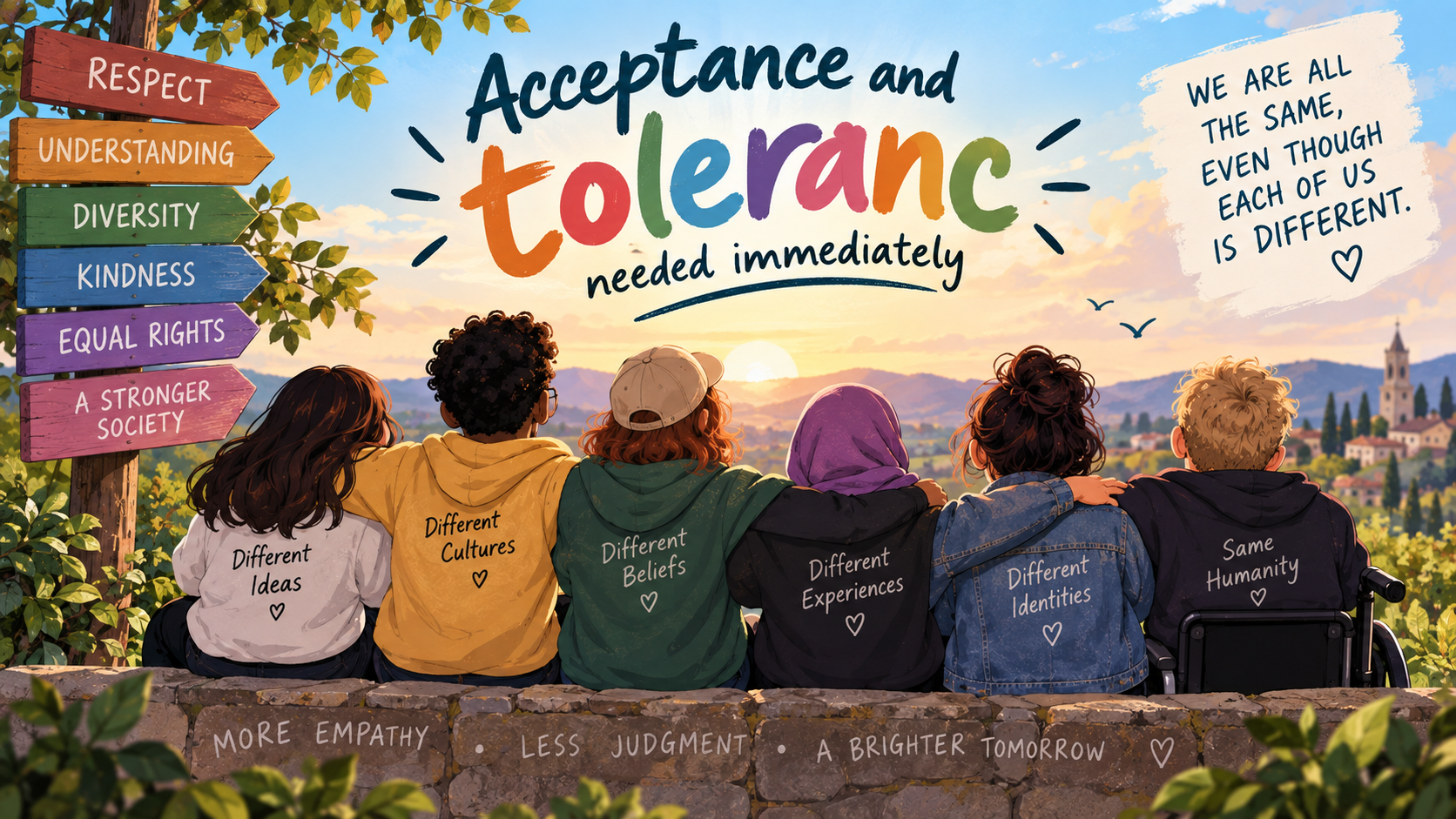
Acceptance and tolerance needed immediately
What is tolerance?
Tolerance means something different to every person; it is something that makes us feel good about ourselves, something that allows us to live in society and accept certain rules and truths of behaviour.
Tolerance is a word that everyone knows and readily uses, but does not necessarily understand. Therefore, we can say that tolerance is not necessarily understood, even though many people consider themselves tolerant.
Definition of tolerance
According to the PWN dictionary, it is respect for other people's views, beliefs and preferences that differ from one's own.
Tolerance and acceptance
Remember!
Tolerance does not necessarily mean accepting another person's behaviour or views.
Tolerance means respecting someone's behaviour and views, even if we do not like them.
This respect applies only to behaviour and beliefs that do not harm other people.
Tolerance is the ability to recognise and respecting other people's opinions, actions and behaviours. In other words, if you have the ability to respect the opinions, actions, customs or behaviours of others, you are, by definition, tolerant.
What is tolerance?
RESPECT
Patience and understanding for differences.
RESPECT FOR OTHERS
Respect for other people's feelings, views, preferences, beliefs, customs and behaviour, even if they are completely different from or completely contrary to your own.
RECOGNITION OF THE RIGHTS OF OTHERS
Respect for other people's freedom, their thoughts and opinions, and their way of life.
Tolerance is the ability to recognise and respecting other people's opinions, actions and behaviours. In other words, if you have the ability to respect the opinions, actions, customs or behaviours of others, you are, by definition, tolerant.
Reasons for intolerance
- Lack of knowledge
- Selfishness
- Cultural stereotypes
- Misunderstanding
- Fear
- Public pressure
- Aversion
- Poor upbringing
- Sense of threat
- Hostility
Tolerance is appreciating the richness that comes from diversity.
Those who are tolerant...
- Tries to understand those who, in his opinion, are mistaken.
- Approaches those who think differently.
- Believes that everything in the world has advantages and disadvantages.
- Thinks: "Fortunately, we are who we are."
- Finds pleasure in diversity.
- He seeks the truth in others.
- He likes to ask questions.
Tolerance is the ability to recognise and respecting other people's opinions, actions and behaviours. In other words, if you have the ability to respect the opinions, actions, customs or behaviours of others, you are, by definition, tolerant.
Those who are not very tolerant...
- Forgives, but hides the mistakes of others.
- Does not accept those who think differently from them.
- Thinks they are the 'better' part of society.
- Says: what bad people there are.
- Teaches others the truth.
- He likes to respond.
Tolerance is the ability to recognise and respecting other people's opinions, actions and behaviours. In other words, if you have the ability to respect the opinions, actions, customs or behaviours of others, you are, by definition, tolerant.
Those who are intolerant...
- Believes that they are always right and that others are wrong.
- They distance themselves from those who think differently.
- Declares that some races and cultures are superior to others.
- Wants everyone to think the same way (as they do, of course).
- Says: only I am good!
- He says there are too many different ways of thinking.
- He thinks freedom is evil.
- He does not want to listen.
Tolerance is the ability to recognise and respecting other people's opinions, actions and behaviours. In other words, if you have the ability to respect the opinions, actions, customs or behaviours of others, you are, by definition, tolerant.
Intolerance
An example of intolerance at school is mocking someone's hobby. Some people, when revealing their interests, e.g. in stamps, old coins and postcards, often expose themselves to silly criticism for cultivating "unfashionable" fields. The same applies to listeners of classical music or old songs. Any delay in following "fashion" is suppressed.
Tolerance is the ability to recognise and respecting other people's opinions, actions and behaviours. In other words, if you have the ability to respect the opinions, actions, customs or behaviours of others, you are, by definition, tolerant.
Signs of intolerance
- Hostility
- Physical aggression
- Mocking
- Psychological aggression
- Aversion
- Verbal aggression
- Name-calling
- Gossip
Let us consider, so, are we tolerant?
The benefits of tolerance
- Peace
- Respect
- Friendship
- Care for the immediate environment
- Positive attitude towards other people
Tolerance is the ability to recognise and respecting other people's opinions, actions and behaviours. In other words, if you have the ability to respect the opinions, actions, customs or behaviours of others, you are, by definition, tolerant.