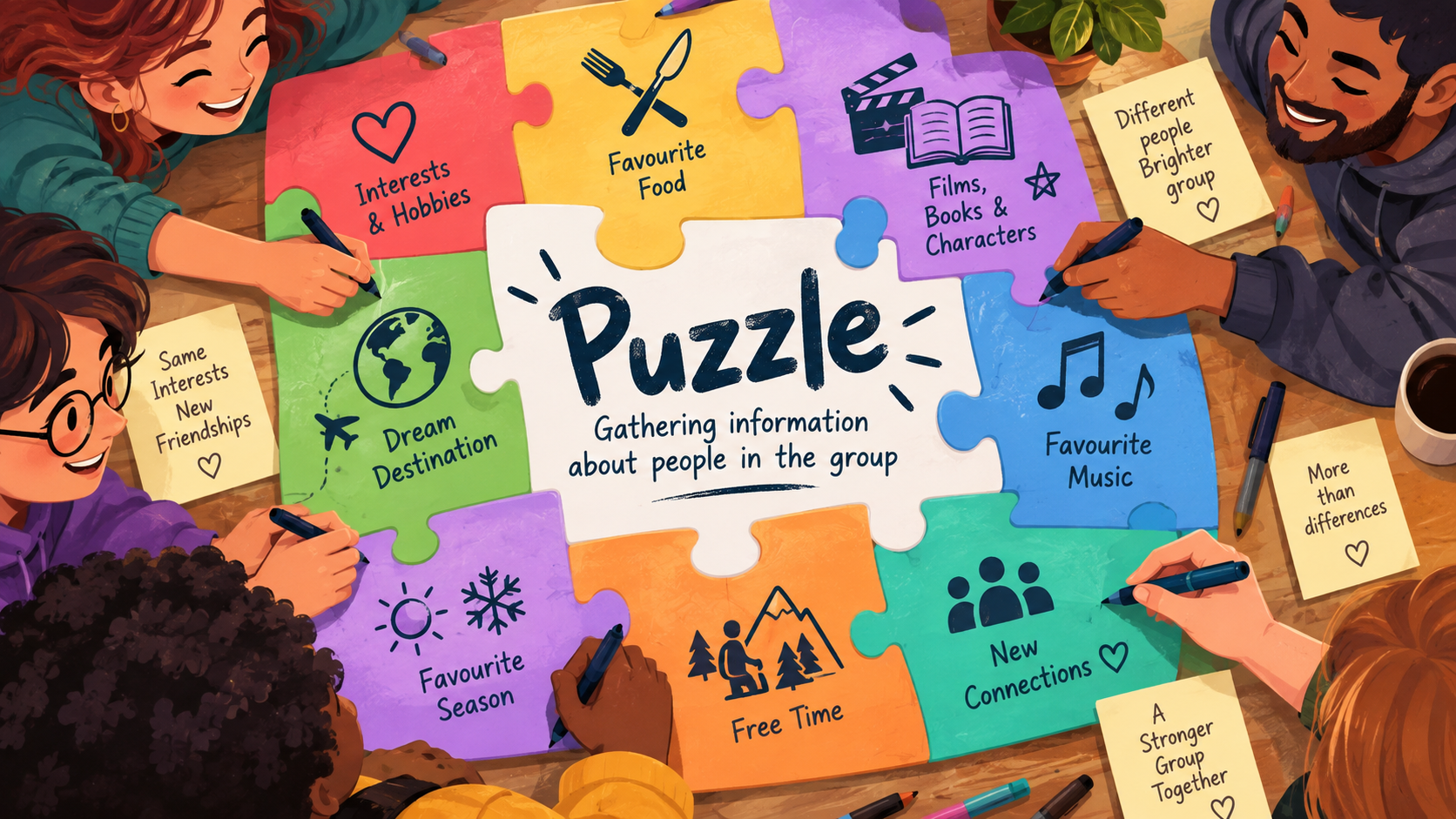
Purpose of the exercise:
- noticing similarities and differences among group members,
- building a sense of belonging,
- encouraging interaction and cooperation,
- strengthening group cohesion,
- creating opportunities for informal conversation.
Procedure:
Each participant receives a sheet of paper divided into several sections (e.g. 4, 6, or 8 fields).
The facilitator presents categories that will be used in the activity. Examples include:
- interests and hobbies,
- favourite food,
- favourite film, book, or fictional character,
- favourite season,
- dream holiday destination,
- favourite music,
- preferred way of spending free time.
In each section, participants write, draw, or place a symbol representing their answer to the given category. Artistic skills are not important; simple words or symbols are sufficient.
Once the sheets are completed, participants move around the room and look for people who share the same or similar answers.
When participants discover a similarity, they sign their name in the corresponding section of the other person's sheet. Multiple signatures can be collected in each category.
Participants continue circulating until they have spoken with several different people and gathered as many signatures as possible.
As an alternative for groups with limited mobility or time, the facilitator can read out individual categories and participants can indicate agreement by:
- raising their hand,
- showing a "yes" card,
- standing up,
- moving to a designated area of the room.
At the end of the activity, participants return to the circle and briefly reflect on:
- which similarities surprised them,
- whether they discovered any unexpected connections,
- what they learned about the group.
Methodological tips:
- avoid overly personal or sensitive categories,
- emphasise that participants may choose not to answer any category,
- remind participants that differences are as valuable as similarities,
- avoid commenting on the number of people in particular groups,
- encourage respectful curiosity rather than comparison or competition,
- adapt categories to the age, interests, and needs of the group,
- allow participants to use drawings, symbols, or words according to their preferences.